
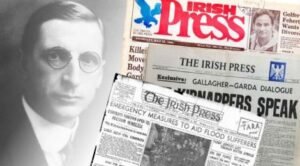

“Truth in the News” was the motto of the Irish Press, first printed in
Dublin on September 5,1931. The newspaper was available for Irish
readers until May 25,1995. During its sixty plus years of publication,
the paper played a central role in reporting Irish politics and cultural life.
The establishment of the Irish Press was the idea of Eamon de Valera,
a prominent Irish political leader whose political career spanned a half
century from 1917 to 1973.
Hello, this is John Conlan, host of The Rocky Road to Dublin on
KBMF, and welcome to this episode of The Harp Without the Crown,
where I will be discussing the establishment of the Irish Press
newspaper and the role played by the Butte Irish community in
assisting with the funding of the newspaper.
During the 1920’s, Eamon de Valera believed Ireland needed a truly
national newspaper to combat the dominance of British newspapers
being circulated in Ireland. He felt the British newspapers did not give
an accurate account of the political and social conditions in Ireland. De
Valera wanted “to give truth in the news…that will be the chief aim of
the Irish Press…the Irish Press will be a truthful journal and a good
neighbor.” In 1922 he wrote, “the propaganda against us is
overwhelming…we haven’t a single daily paper on our side and only
one or two weeklies.”
By 1927 de Valera had started to collect subscriptions for the
funding of the Irish Press. The newspaper would distinguish itself from
the British newspapers by reporting on events in Ireland from an Irish
perspective. He had great confidence his newspaper endeavor would
be a success after visiting American cities, including Butte, in 1919.
The purpose of this trip was to raise funds for the newly formed Irish
“counter government.”
He also used his visit to observe reporting methods and press
operations of American newspapers. He was impressed with how
American newspapers utilized strong local reporting and editorial
pieces, which de Valera hoped would be the model for the Irish Press
newspaper. His 1919 visit to Butte was positively covered on the front
pages of several Butte newspapers as well as his address to 10,000 at
Butte’s Hebgen Field. This positive newspaper coverage in Butte
mirrored other American newspapers, where he basked in favorable
newspaper coverage.
It is important to note that while in America, de Valera raised
significant sums of money for his loan/bond program to support the
“counter government” of Ireland formed in 1919. He raised $107,000 in
Butte, which was part of the six million raised in the United States.
(The Butte money has a value of $1,500,000 in today’s money.)
These same bond holders would be asked eight years later to
transfer their bond subscriptions stock to his Irish Press newspaper.
This money would then be used to help fund newspaper operations and
the request would reach approximately 1,200 to 1,500 Butte bond
holders. In 1927 the bonds were reported to be valued between
$50,000 to $60,000, and were to be redeemed at 60 cents on the dollar.
In 1927, De Valera wrote to his American allies noting that a large
percentage of those who subscribed to the bond program “will be
prepared to invest the money if properly approached.” These bond
holders were then sent a letter from the Office of the American
Association for the Recognition of the Irish Republic headquarters in
Washington D.C. It read, “To the Holders of the bonds of the Irish
Republic…we urge you to transfer it (money) to the securities of the
Irish Press, Limited, which is the name of the newspaper that is about
to start in Dublin to fight Dublin’s battles…the Irish cause has been
handicapped by the lack of an independent and pro Irish press…we are
in the stranglehold of an alien press.”
Butte subscribers to the 1919 bond drive would have received this
letter, as well as a transfer blank form to be filled out and returned to
the committee in Washington D.C. It was a persuasive letter but
deliberately short of demands. It likely resonated with the Butte Irish
community who probably felt the newspaper might play a part in
assisting the Irish independence movement. Most wanted to see an
independent Ireland in their lifetime and de Valera’s reputation as a war
hero fighting the British during the Easter Rising provided credibility to
the request.
In 1928 and 1929 de Valera sent two Irish patriots and
revolutionaries, Frank Aiken and Ernie O’Malley, to America to lobby
and gain support for subscribing to the Irish Press newspaper. These
were no ordinary men, as both were well known for their patriotism and
bravery in fighting the British during the Irish War of Independence
(1919 to 1921) and battling the Irish Free State troops during the Irish
Civil War (1922 to 1923).
Aiken and O’Malley have incredible biographies. Aiken fought the
British army during the War of Independence in County Armagh in
Ireland’s northeast Province of Ulster. During the Irish Civil War he
served as chief of staff of the anti Free State Treaty Irish Republican
Army. His unit of the IRA was the most active in Ulster during the War
of Independence, primarily due to his leadership and training methods.
Ernie O’Malley was an Irish Republican Army officer during the 1919
to 1921 Irish War of Independence and served as a senior commander
of the anti Free State Treaty forces during the Irish Civil War, 1922 to 1924.
During the course of these conflicts he was wounded, captured,
tortured, and participated in a hunger strike. Later in life he wrote four
books about his war experiences: “Another Man’s Wounds,” “The
Singing Flame,” “Raids and Rallies,” and “Sean Connolly of Longford.”
During the 1950’s, his interviews of over 450 survivors of those conflicts
served as the basis for the material covered in his “Raids and Rallies”
and “Sean Connolly of Longford” publications.” Despite his war
experiences with the British army, he most famously said, “I have
nothing against the British…I just don’t want them in Ireland…remove
yourselves and leave us to ourselves.”
Frank Aiken’s visit to Butte was sponsored by various Irish American
organizations in the city. He spoke on November 15,1928 to a large
audience assembled at 51 West Copper Street. He began his talk by
reminding the audience that there is “no paper in Ireland of national
importance and those in circulation have shown a strong anti-nationalist
spirit.” He described how a newspaper subscription was successfully
progressing in Ireland and Americans were being asked to help by
subscribing to the newspaper. The goal in America was to secure
$500,000 in subscriptions of which $100,000 had already been
pledged.
A major portion of his speech was devoted to asking the Butte Irish
community to raise money for the Irish Press by establishing a
committee to handle the 1919 stock transfer monies to the Irish Press
newspaper. Two days later, a committee of twenty was established to
handle the 1919 stock transfer from the Butte community, specifically
the 1,200 to 1,500 Butte stock owners from the 1919 Bond Drive. John
O’Sullivan and Michael Mullane, both of Butte handled the committee’s
financial affairs. There was no definite quota set for Butte, but
newspaper reports noted the committee hoped to raise several
thousand dollars in Butte.
A few months later Ernie O’Malley arrived in Butte and addressed
250 members of the Thomas Ashe Council of the Sarsfield Social Club.
His address on March 4,1929 described the political and economic
conditions in Ireland but spent most of his speech outlining funding
procedures for the publication of the proposed Irish Press newspaper in
Dublin. Like Aiken, he noted subscriptions were progressing and had
raised $500.000. The newspaper would be published when another
$500,000 more was raised. He noted “the paper will acquaint
Americans with conditions in Ireland.”
Butte newspapers reported that O’Malley was met with an
enthusiastic response as he declared “no purely Irish news ever gets
abroad or even circulated within Ireland, such views are published
throughout Ireland are carefully edited to remove the Irish angle…the
paper will be published in Dublin to exemplify Irish ideals and Irish
thought…news will be presented with an Irish point of view rather than
from a foreign.”
During O’Malley’s visit he found time to visit the Butte Christian
Brothers School, where to his surprise, was greeted by a number of the
School’s Brothers who had been his teachers during his college days in
Dublin. This was a truly memorable moment for him while in Butte.
Unfortunately, the historical record is incomplete concerning the
progress of the Irish Press subscription drive in Butte. As previously
noted, a committee was established to solicit subscriptions. It seems
likely there was money raised in Butte, based on its past history of
supporting and contributing to various Irish organizations, such as the
Land League,Gaelic League, and Friends of Irish Freedom, to name a
few.
Despite the incomplete documentation of the subscription drive in
Butte, it is important to note that any financial contribution connected
the Butte Irish community to Ireland during a critical time period in
Ireland’s history, as Ireland was moving toward an independent Irish
Republic, achieved in 1949.
This is John Conlan and thanks for listening to this episode of The
Harp Without the Crown.